



%E2%80%8B-%E2%80%8B%20%E2%80%8B-1.png?length=256&name=Pink%20B__Align%20(Content%20Alignment)%E2%80%8B-%E2%80%8B%20%E2%80%8B-1.png)
%E2%80%8B-%E2%80%8B%20%E2%80%8B-1.png?length=256&name=__Align%20(Content%20Alignment)%E2%80%8B-%E2%80%8B%20%E2%80%8B-1.png)

%E2%80%8B%20%E2%80%8B.png?length=256&name=__Implement-%20(Technology%20Implementation)%E2%80%8B%20%E2%80%8B.png)
%E2%80%8B.png?length=256&name=Blue%20B__Adopt-%20(Technology%20Adoption)%E2%80%8B.png)
%E2%80%8B.png?length=256&name=__Adopt-%20(Technology%20Adoption)%E2%80%8B.png)





%E2%80%8B-%E2%80%8B%20%E2%80%8B.png?length=256&name=__Align%20(Content%20Alignment)%E2%80%8B-%E2%80%8B%20%E2%80%8B.png)





.png?length=256&name=Pink%20B__Activate%20(Content%20Activation).png)
.png?length=256&name=__Activate%20(Content%20Activation).png)

.png?length=256&name=Data_%20Outcome_White%20BG%20(1).png)












%E2%80%8B-%E2%80%8B%20%E2%80%8B.png?length=256&name=Purple%20B__Align%20(Content%20Alignment)%E2%80%8B-%E2%80%8B%20%E2%80%8B.png)
%E2%80%8B%20%E2%80%8B.png?length=256&name=Blue%20B__Implement-%20(Technology%20Implementation)%E2%80%8B%20%E2%80%8B.png)




%E2%80%8B-%E2%80%8B%20%E2%80%8B.png?length=256&name=Blue%20B__Align%20(Content%20Alignment)%E2%80%8B-%E2%80%8B%20%E2%80%8B.png)
%E2%80%8B%20%E2%80%8B.png?length=256&name=Cyan%20B__Implement-%20(Technology%20Implementation)%E2%80%8B%20%E2%80%8B.png)
.png?length=256&name=Blue%20B__Activate%20(Content%20Activation).png)








Every Marketing team wants to deliver increasingly personalized content, but very few have a content operating model capable of supporting them at scale. The organizations that get the most out of their AI investments don’t just generate more content, they rethink how content gets created, governed and reused. That approach starts with modular content.
Modular content is one of the foundational capabilities required to deliver personalization at scale. Our whitepaper, The Enterprise Blueprint for Personalization at Scale, explores the foundational shift needed to enable personalized customer experiences consistently and sustainably.
Consider a single global campaign running across 25 markets, 5 channels, and 3 audience segments. Even with a single creative concept, that can result in 375 potential content variations before language, regulatory, or channel-specific requirements are considered. Without modular content, much of that effort is manual, needing marketers, agencies, compliance and reviewers to create and approve content repeatedly.
Now, imagine that for the same campaign, a Marketing Manager can reference existing high-performing content, not just off the top of their head, but by accessing a library of ready, approved and reusable granular content from a centralized content system like a DAM. AI has already analysed and pre-classified the previous performance of elements like headlines, imagery, product claims and CTAs, recommending the most effective, approved elements and assembles a draft tailored to the selected channel, market, and audience. This enables the team to easily iterate over the same process at scale.
Your team already has ownership of the building blocks to make this a reality.
The difference is, they’re maintained as final assets rather than reusable components.
Elements like the hero imagery, brand logos, calls-to-action, comparison tables and other approved assets can be used to accelerate campaign delivery while maintaining content personalization and nuance, while remaining compliant with brand standards across channels, and reducing production effort and agency costs in the process.
For this approach to succeed in practice, you need to change the idea of content as finished assets and think more in terms of reusable components with individual performance that you’re able to measure at a granular level. Instead of creating another email, teams should be able to assemble existing approved headlines, imagery, claims, calls-to-action, and legal copy into new experiences. Every approved component becomes an asset that can be reused, measured, and continuously improved across campaigns.
Selection of a new technology platform that enables you to harness the power of modular content is just one part of the equation. The real challenge in the adoption of modular content in a Marketing org is really one of organizational redesign.
In principle, reusing existing, high-performing components isn’t difficult. The hard part is enabling teams across markets, functions, brands and time zones to collaborate with each other effectively without defaulting to siloed ways of working, or worse, expecting them to navigate a dozen or so approvals over several weeks to get access to reusable content.
Additionally, Marketing teams are also expected to support multiple markets, channels, and audience segments while adapting content to local nuances. In regulated industries, frequent compliance and regulatory updates add another layer of complexity, making content reuse even more difficult to sustain.
It’s no surprise, then, that modular content remains vastly underutilized in most marketing organizations.
As a result, organizations often end up at one of two extremes: recreating content from scratch or relying on generic AI-generated assets that lack brand context, compliance aspects, and relevance, and fail to generate engagement from target audiences. Neither approach delivers scalable content personalization.
Why this is a big problem:
- Recreation is expensive, requiring investment in agency support, content creation and review cycles
- Effort is being duplicated, when Marketing teams could be focusing their energies on creating value for customers rather than starting from scratch
- Campaign launches are delayed due to the manual lift required and getting all the approvals for fresh content in place prior to launch
Modular content changes the way teams approach content creation. Instead of treating every campaign as an entirely new project, organizations invest once in reusable, approved components that can be assembled into multiple experiences across channels, audiences, and markets. As reuse increases, the cost and effort of creating each new asset decreases, while consistency and speed improve.
Efficient scaling involves creating content once and enabling it to be reused intelligently, rather than increasing team sizes, investing in expensive Gen-AI enabled solutions, or automating inefficient processes in the content lifecycle.
To fully harness the power of AI and modular content, your Marketing Operations ecosystem needs strong foundations. To do that, you need a practical go-to framework that you can adapt to your organization to move from manual to modular to AI-led:
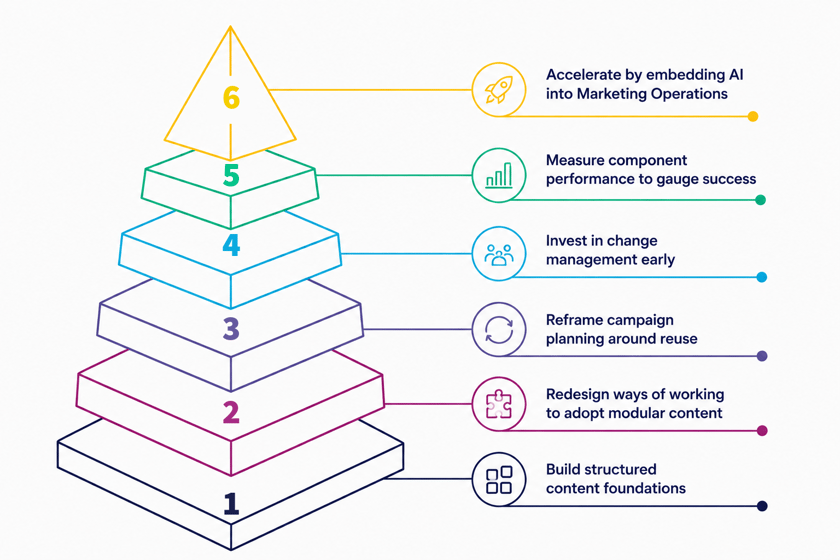
- Build structured content foundations: Create a well-defined, governed, flexible, and unified data model supported by strong metadata standards that are consistently understood and adhered to across the org. Data is the baseline for any kind of transformative work. The AI layer fails if data is missing or doesn’t make sense, i.e. it isn’t primed for generating useful insights.
- Redesign ways of working to adopt modular content: Rally your teams and leadership around the imperative to adopt modular content. Oftentimes, this is easier said than done because different teams tend to work in their own silos. E-commerce, Digital, Omnichannel, Compliance, Brand Marketing all work within the boundaries of their established processes and it’s hard to sell a new mandate. A clear business case tied to a long-term strategic vision and clear outcomes should help align teams on this journey.
- Reframe campaign planning around reuse: For your next campaign, start by asking which approved content components already exist in your DAM. How can we create content once for multiple channels and possibly even across markets? From recent campaigns, have our teams been able to identify our most repeated component types – CTAs, banners, logos, subject lines? Start small and focus on the few content types that account for most of your content production efforts.
- Invest in change management early: Introducing a new technology or process involves breaking down barriers between teams and ensuring that everyone is aligned and level set with respect to how they adopt the new technology or process. Invest in change management right at the outset, at the planning stage, to get organizational buy-in and ensure that all involved stakeholders and users have the tools and information they need to understand and adopt the change.
- Measure component performance to gauge success: Rather than looking only at which final assets performed well, look at which components and combinations contributed the most. Set and measure internal metrics such as rate of reuse or downloads of approved components to track whether or not modular content is being leveraged and delivering value.
- Accelerate by embedding AI into Marketing Operations: Embed AI across your content supply chain and incentivize teams to leverage AI to automate previously manual processes as much as possible, in line with business objectives. Utilize AI from predicting and automating metadata all the way through to localized adaptation, translation, finished content combinations and surface performance insights.
All of this is sustainable with strong governance. Content reuse requires clear ownership, content standards, lifecycle management, and well-defined approval processes to ensure content remains current, compliant, trusted, and ready for reuse over time. Governance becomes more critical as AI starts to become embedded within content operations. In our Content Conversations podcast series - Episode 3: AI Governance in DAM: An Introduction, we explore why AI governance is increasingly becoming a part of DAM and responsible AI adoption.
Your future-ready marketing ecosystem relies on the existence of standardized, reusable, organized content today that can then be accelerated by AI to deliver the scale needed tomorrow. The journey from manual to modular isn’t made by deploying AI and automation to produce content quicker. It’s done by building a content supply chain that is intelligent at its roots.